As Iranians celebrate the world over, U.S. intervention is only a small piece of the geopolitical puzzle.
The images coming out of Iran and from Iranian communities abroad are the kind people remember for years.
In some cities inside Iran, people were filmed dancing, cheering, and toppling regime monuments shortly after the death of Ali Khamenei reached the international airwaves.
Reuters verified celebration videos from places including Karaj, Izeh, Dehloran, and Galleh Dar. But unverified videos proliferate on social media. Outside Iran, diaspora crowds gathered in Europe, Seoul, and Los Angeles, celebrating what many see not simply as a military strike, but as the first visible crack in a system that has ruled by fear for nearly half a century.
In this moment of revolution, it will not be honest to tell the story as if Washington alone created it. U.S. intervention is the loudest piece of the puzzle right now. It is not the only piece, and maybe not even the deepest one.
The Islamic Republic was already badly weakened long before the bombs fell this weekend.
Lest we forget, Iran had just come through the bloodiest crackdown since 1979 after protests that began in late December over economic hardship and swelled into direct challenges to clerical rule. Officials had warned Khamenei public anger had reached the point where fear was no longer enough to hold the country together.
That matters, because revolutions are not dropped from the sky. They are prepared by years of corruption, humiliation, repression, and decline. The Iranian people prepared this moment themselves. The regime’s brutality prepared it too. Thousands were killed in January’s crackdown, according to rights groups and official figures cited by major media outlets, and even after the streets quieted, the anger did not disappear. It went underground. It waited. So when Khamenei was killed and the regime’s aura of invincibility shattered, there were already countless Iranians ready to interpret that shock not as foreign aggression alone, but as an opening.
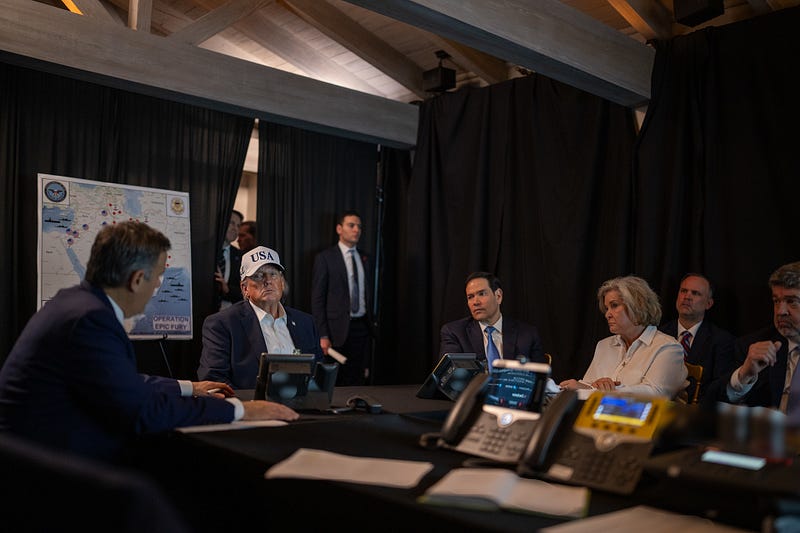
The American role, obviously, is enormous. The U.S. joined Israel in a major strike campaign that killed Khamenei and hit the regime’s command structure, and Iran has now been pushed into an interim leadership arrangement while it scrambles to preserve continuity. Today, Reuters reports that President Masoud Pezeshkian, Ayatollah Alireza Arafi, and Judiciary Chief Gholamhossein Mohseni-Ejei are temporarily sharing leadership duties while the system tries to survive the succession crisis. That is not a sign of confidence. That is the look of a regime in emergency mode.
But the Gulf story is more complicated than “America attacked Iran.” For weeks, key Arab states were trying to prevent a regional war. Reuters reported that Saudi Arabia and Qatar engaged in intense diplomacy with Washington in January to avoid a U.S. strike, and Oman was mediating talks that its foreign minister later said had been undermined by the attack.
At the same time, the picture behind the scenes appears more mixed: The Washington Post reported that Saudi Crown Prince Mohammed bin Salman made private calls urging Trump toward military action, even while publicly backing diplomacy. In other words, the Gulf states were not of one mind, and they still are not. But once Iran began firing at Gulf states and threatening the wider region, that ambiguity started to collapse. Iranian attacks on Gulf territory hardened Arab support for the U.S.-Israeli campaign, because Tehran had done the one thing Gulf rulers fear most: bring the war directly to their doorstep.
Russia and China have played a role too, though not in the way Tehran may have hoped. Russia spent the last year deepening ties with Iran through a 20-year strategic partnership covering defense and economic cooperation — but never a mutual defense clause.
China, meanwhile, has been the regime’s economic lifeline: Reuters reported in January that China bought more than 80% of Iran’s shipped oil in 2025. That mattered. It kept money flowing into a sanctioned, brittle state. And yet now, when the regime is in real danger, Moscow and Beijing are offering what they usually offer: diplomatic language. China has condemned the strikes and called for a ceasefire. Russia has done the same. Neither has shown signs of riding to Tehran’s rescue.
That is why this moment feels different. Iran’s rulers are discovering the difference between having partners and having saviors. They had partners for sanctions evasion, oil sales, military cooperation, and anti-Western theater. What they do not appear to have is a cavalry.
None of this means the revolution is guaranteed to succeed. According to people familiar with the matter, U.S. officials remain skeptical the battered and fragmented opposition can topple the system quickly. They may be right. The Islamic Republic still has institutions, guns, clerics, networks, and men with something to lose. A wounded regime can be more dangerous than a confident one. Iran could still lurch into a harsher military-clerical consolidation instead of a free future.
But for the first time in a very long time, the regime looks mortal — it can be wounded. And badly. That alone is historic. And if revolution really is at hand in Iran, it will not belong to Washington, Riyadh, Moscow, Beijing, or Jerusalem.
It will belong to the Iranian people who kept resisting long after most of the world stopped paying attention.
(Contributing writer, Brooke Bell)